Mechanic / Crystal PvP / Intermediate
Learn how D-tapping combines knockback, pre-placed Obsidian and two crystal damage windows to deal rapid consecutive damage in Crystal PvP.
Crystal PvPIntermediate9 min readJavaVerified Aug 12, 2026
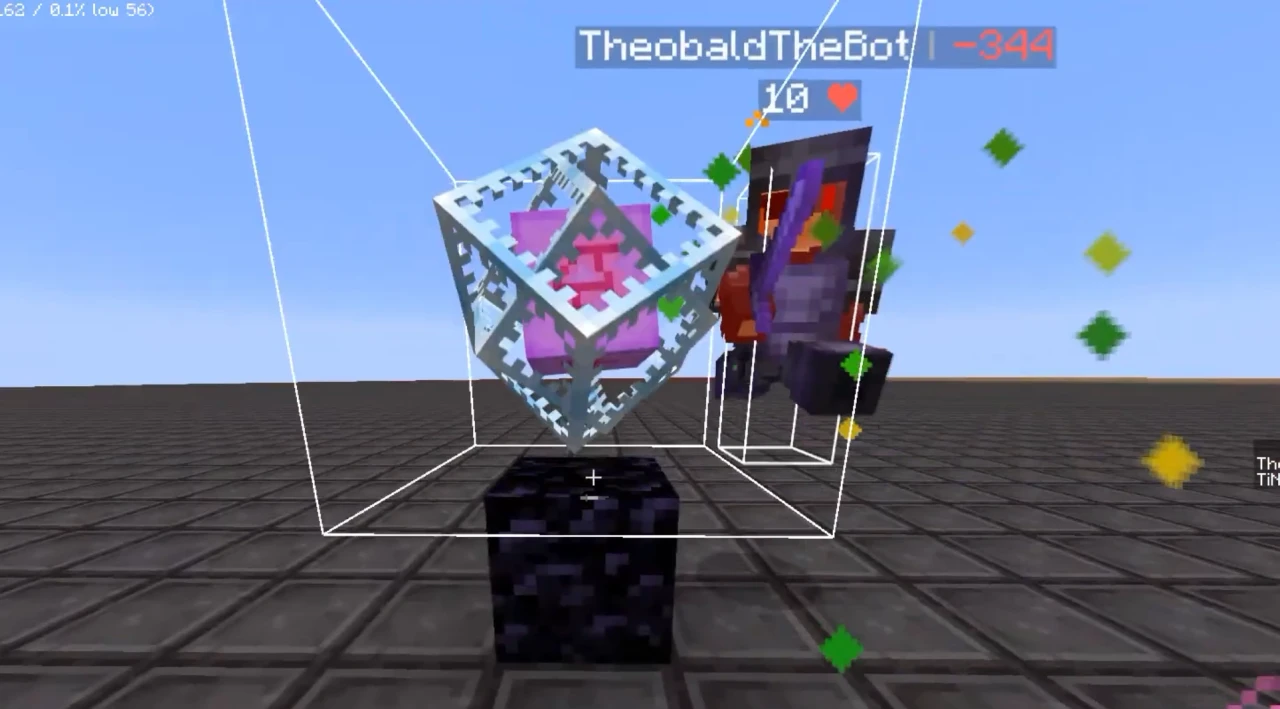
The D-tap, short for double tap, is a Crystal PvP technique that allows Player 1 to deal two rapid damage instances to Player 2 within a very short period of time.
In this guide, Player 1 refers to the player performing the D-tap and Player 2 refers to the opponent.
The technique combines a sword hit and an End Crystal explosion during the same damage window, followed by a second End Crystal explosion during the next available damage window.
When performed correctly, a D-tap can pop two Totems of Undying in rapid succession or pop one Totem and kill Player 2.
A consistent D-tap mainly depends on three things:
The basic sequence is:
Related guides based on the learning path, explicit relationships, and matching topic metadata.
| Event | Timing | Purpose |
|---|
| Sword hit | Start of the first damage window | Create knockback and begin Player 2's trajectory |
| Place Obsidian | Immediately after the sword hit | Place the crystal base ahead of Player 2 along their trajectory |
| First Crystal | Same damage window as the sword hit | Connect the first crystal while Player 2 is moving above the Obsidian |
| Second Crystal | Next available damage window | Create the second rapid damage instance |
Player 1 first hits Player 2 with the Knockback sword.
The sword hit launches Player 2 and creates the trajectory used for the setup.
Immediately after the hit, Player 1 places the Obsidian ahead of Player 2 in the direction they are traveling.
Player 1 then places and breaks the first End Crystal while Player 2 is moving through the intended position and while the same damage window is still active.
Once Player 2 can receive damage again, Player 1 places and breaks the second End Crystal.
Player 1 first needs to get into a position where they can hit Player 2 and immediately begin the D-tap.
Player 1 can simply move toward Player 2 and hit them with the sword once within range.
This gives Player 1 direct control over their position and is usually the simplest way to begin a D-tap.
Player 1 can also use an Ender Pearl to close the distance.
The pearl should generally not land directly on Player 2.
A direct pearl collision can cause Player 1 to be launched slightly upward. Being airborne makes movement and aiming less predictable and can delay the sword hit.
That extra delay gives Player 2 more time to react to the setup.
For example, Player 2 may:
The goal of the pearl is therefore to close the distance without disrupting Player 1's ability to immediately hit Player 2.
After approaching Player 2, Player 1 hits them with a sword.
A Knockback I sword is useful for D-tapping because the additional knockback makes it easier to place Player 2 into the required position.
This is especially useful against Netherite armor, where normal sword knockback may not provide enough displacement for a consistent setup.
The purpose of the knockback is not simply to launch Player 2 as far as possible.
It is to create a predictable trajectory that gives Player 1 enough time and space to place the Obsidian and crystals while Player 2 is airborne.
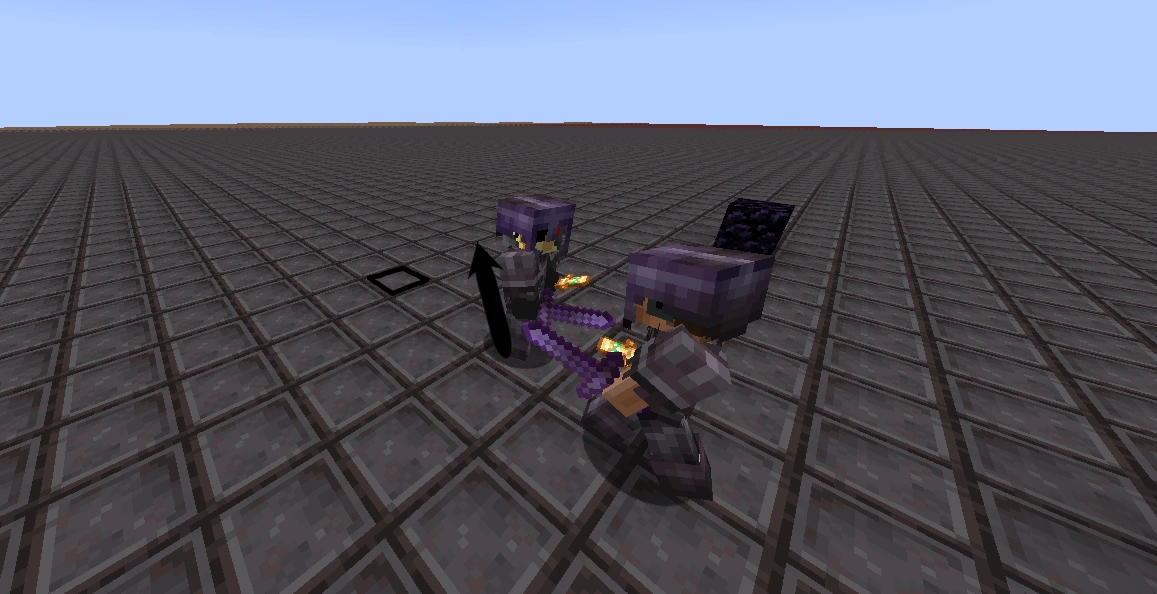
The sword hit happens before the Obsidian is placed.
After the hit, Player 1 reads Player 2's trajectory and places the Obsidian ahead of them.
The placement therefore depends on quickly predicting where Player 2 is going to travel and positioning the Obsidian before Player 2 passes the useful crystal position.
Player 1 places the Obsidian after hitting Player 2.
The sword hit first sends Player 2 into the air and creates the trajectory for the setup.
Player 1 then places the Obsidian ahead of Player 2, where they are expected to travel.
The Obsidian should be as close to Player 2 as possible while still being inside their expected trajectory.
Because the Obsidian is placed after the hit, Player 1 needs to place it quickly enough to leave time for the first End Crystal to be placed and broken during the same damage window as the sword hit.
The exact position matters because Player 2 needs to be in a suitable position above the Obsidian when the End Crystal is broken.
If Player 2's feet are still below the Obsidian, the block can obstruct part of the explosion and reduce the damage.
The goal is to use the trajectory created by the sword hit to quickly place the Obsidian where the crystals can hit Player 2 effectively.
After the sword hit, Player 1 places the Obsidian in Player 2's trajectory.
Player 1 then places an End Crystal on the Obsidian and immediately breaks it.
The sword hit has already started Player 2's current damage window.
The Obsidian placement and first crystal therefore need to happen quickly enough for the first crystal to be broken during that same damage window.
This creates the first crystal damage instance used by the D-tap while Player 2 is still moving through the intended trajectory.
After Player 2's current damage window ends, Player 2 can receive damage again.
Player 1 then places and breaks the second End Crystal.
The second crystal creates the second rapid damage instance.
The timing between the two crystals is extremely important.
The crystals should not simply be broken as quickly as possible. They need to be broken across the correct damage windows.
Player 2's position in the air determines how effective the crystals will be.
Player 1 wants Player 2 to remain:
If Player 2 falls behind or below the Obsidian before the crystal is broken, the Obsidian can obstruct the explosion.
If Player 2 is knocked too far away, the second crystal can also become difficult to connect.
The purpose of the sword's knockback is therefore to create a trajectory that lets Player 1 place the Obsidian after the hit and still keep Player 2 in a position that works for both crystals.
Knockback can also be used to change Player 2's trajectory.
Instead of sending Player 2 directly away from Player 1, the sword hit can shift their trajectory to one side.
This is useful when Player 1 cannot safely approach Player 2 from the ideal direction.
By changing the trajectory with the sword hit, Player 1 can place the Obsidian in a more favorable position immediately afterward while still keeping Player 2 above it.
This makes Knockback a tool for controlling Player 2's position, rather than simply creating distance.
This type of positional control is explained in more detail in Knockback Displacement.
Blast Protection affects D-taps because it reduces explosion damage and explosion knockback.
This can make a conventional D-tap considerably more difficult because Player 1 normally relies on Player 2 being moved by the explosions while airborne.
With multiple pieces of Blast Protection, Player 2 can receive significantly less explosion knockback, making it harder to keep them in the correct position for the second crystal.
This does not mean D-taps are always impossible against Blast Protection.
If Player 2 is already positioned above Player 1, Player 1 does not need to rely as heavily on explosion knockback to create the required vertical position.
In these situations, the D-tap can still be possible because Player 2 is already in a suitable position.
| Mistake | What happens | Correction |
|---|---|---|
| Obsidian placed too far away | Player 2 may leave the effective crystal position before the crystal is broken | Place the Obsidian closer along the trajectory created by the sword hit |
| Obsidian placed incorrectly | The block can obstruct part of the explosion | Aim for Player 2 to be sufficiently above the Obsidian |
| Obsidian placed too slowly | There may not be enough time to connect the first crystal during the sword hit's damage window | Place the Obsidian immediately after the sword hit |
| Not enough knockback | Player 2 may not become airborne enough for the setup | Create enough displacement to move Player 2 into the intended crystal position |
| Too much knockback | The second crystal becomes difficult to connect | Avoid sending Player 2 beyond the useful crystal position |
| First crystal too late | The first crystal misses the intended damage window or Player 2 has time to fall or escape | Place the Obsidian and connect the first crystal quickly after the sword hit |
| Second crystal too slow | Player 2 gets more time to react between the two damage instances | Prepare the second crystal for the next available damage window |
| Losing aim after a pearl | Player 1 has to reacquire Player 2 before performing the sword hit | Land where the sword hit can follow immediately |
| Breaking the crystals at the wrong time | The intended two rapid damage instances are not created | Separate the crystal breaks across the correct damage windows |
The main purpose of a D-tap is rapid damage.
A successful D-tap can:
Because the two damage instances happen within a very short period of time, Player 2 has very little time to react between them.
This makes the D-tap an important offensive technique in Crystal PvP.
The full sequence is:
Approach → sword hit → place Obsidian → first crystal → next damage window → second crystal
Player 1 first hits Player 2 with the Knockback sword to create a predictable trajectory.
Immediately after the hit, Player 1 places the Obsidian ahead of Player 2 and uses it to place and break the first End Crystal during the same damage window.
Once Player 2 can receive damage again, Player 1 places and breaks the second End Crystal.
A consistent D-tap depends on three core ideas:
Learn how to hit an opponent against a wall and place a Cobweb in their head position to trap them during the resulting knockback.
